
How It Works
A structured method for pharmacology learning and clinical reasoning.
Combine focused lessons, retrieval practice and case-based questions with formative assessment, corrective feedback and targeted review. The aim is to strengthen pharmacology knowledge for board-exam preparation and therapeutic decision-making.
Deliberate practice cycle
A seven-step cycle for assessment and targeted review.
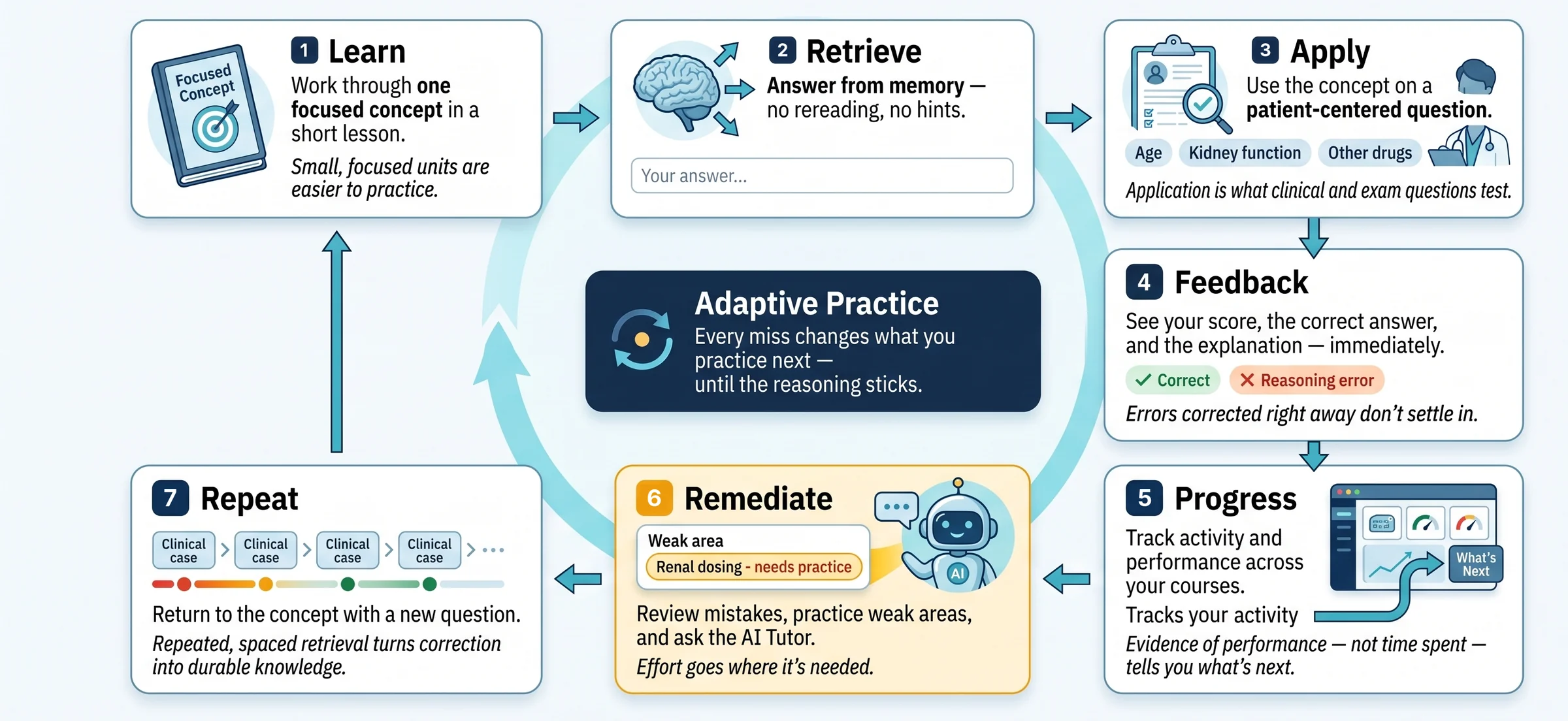
The training cycle
Seven steps for focused study and practice.
- Step 1
Study a defined objective
Study the lesson’s pharmacology concepts and identify the knowledge or decision you are practicing.
Learning purpose: A defined objective gives practice and feedback a specific focus.
- Step 2
Retrieve from memory
Attempt an available question from memory before reviewing the answer or lesson.
Learning purpose: Retrieval practice can strengthen retention and reveal what you cannot yet recall reliably.
- Step 3
Apply clinical reasoning
In clinical questions, connect pharmacology with patient factors, therapeutic benefit, risk and monitoring.
Learning purpose: Case-based application lets you practice explaining a decision using relevant patient information.
- Step 4
Review corrective feedback
Review your score, the correct answer and the explanation provided after assessment.
Learning purpose: Corrective feedback helps identify the gap between your response and the intended reasoning.
- Step 5
Target knowledge gaps
Review missed concepts, use available weak-area practice and consult the AI Tutor after completed assessments.
Learning purpose: Targeted remediation directs further study toward concepts that assessment shows need attention.
- Step 6
Repeat and revisit
Revisit the concept and repeat available practice. Plan additional review over time.
Learning purpose: Repeated retrieval and review distributed over time can support retention.
- Step 7
Monitor progress
Track activity and performance across your courses.
Learning purpose: Formative assessment provides information you can use to plan further study and reassessment.
Study a concept, attempt retrieval and application, review corrective feedback, then practice the areas that need further work.
Three principles guiding practice
Attempting recall can support long-term retention and make knowledge gaps visible.
Use explanations to examine your reasoning, correct misconceptions and plan another attempt.
Focus review and available practice on the concepts you missed, then reassess your understanding.
Knowledge retrieval and clinical application
Retrieve pharmacology principles and apply them to clinical cases.
Recall pharmacological mechanisms and principles.
Recall questions prompt you to retrieve key concepts before reviewing the lesson or answer rationale.
- Mechanisms of action
- Receptors and dose–response
- Pharmacokinetic principles
Evaluate patient-specific therapeutic decisions.
Clinical cases ask you to evaluate therapy choices, patient-specific dosing and monitoring. Review the rationale for the selected answer.
- Which patient factor changes the choice?
- What response or harm do you expect?
- What will you adjust and monitor?
Watch
Memorizing isn’t applying.
See how deliberate practice connects pharmacology principles to patient factors, risks, monitoring and better clinical decisions.
Watch
Feedback and adaptive practice in action.
Formative assessment and remediation
Turn assessment results into a focused study plan.
Review the correct answer and explanation, identify the concept that needs attention and use available review or follow-up practice.
- 1 · FEEDBACKQuick Recall Check2 / 4Illustrative result✓ Mechanism of action✕ Renal dose adjustment
Review the missed concept with the correct answer and explanatory feedback.
- 2 · WEAK AREASRecommendedRenal dosing · needs practice
Suggested review topic based on the assessment result.
Practice weak areasReview mistakesTargeted remediation focuses review on concepts identified in assessment results. Available follow-up questions vary by course.
- 3 · AI TUTORGrounded reviewWhy was my answer wrong? A renally cleared drug accumulates when creatinine clearance falls, so exposure rises… Source: the lesson you just studied
Examine the reasoning and return to the relevant lesson section.
Illustrations of the learner experience. Available practice and follow-up questions depend on each course.
The research behind the method
Learning principles supported by published research.
Research in education and medical training supports retrieval practice, feedback and repeated practice with defined goals. PharmaDrills uses these principles to guide its design; its effects on board scores, clinical performance and patient safety have not been established.
- Retrieval practice
Retrieving information from memory can improve long-term retention compared with rereading alone.
Roediger & Karpicke (2006), Psychological Science 17(3):249–255; Larsen, Butler & Roediger (2008), Medical Education 42(10):959–966. - Deliberate practice
Focused repetition of defined tasks with corrective feedback improves specific clinical skills in medical simulation studies. Transfer to clinical practice depends on the task and training design.
McGaghie et al. (2011), Academic Medicine 86(6):706–711. - Feedback
Feedback can support learning when it clarifies the performance goal, explains the error and identifies an actionable next step.
Hattie & Timperley (2007), Review of Educational Research 77(1):81–112. - Spaced practice
Distributing study sessions over time generally supports longer-term retention compared with a single concentrated session.
Cepeda et al. (2006), Psychological Bulletin 132(3):354–380.
Further reading
Explore the training method and curriculum.
Begin clinical reasoning practice in Module 1.
Five foundational courses, free during launch. No credit card required.