
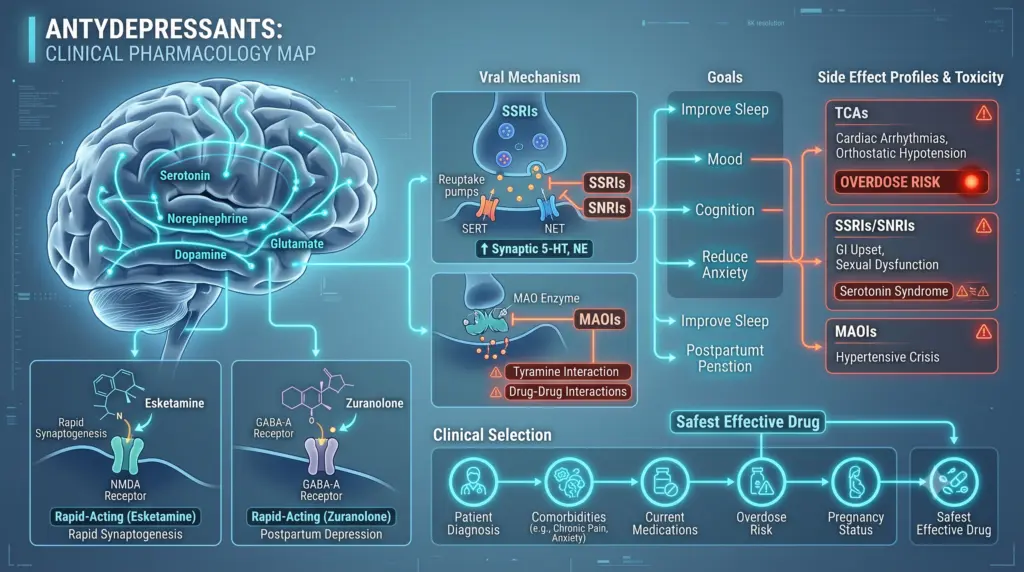
Build a practical clinical pharmacology map of antidepressant mechanisms, indications, onset expectations, safety triage, adverse effects, interactions, overdose toxicity, special populations, and patient-specific treatment selection.
Course Content
01. Antidepressants: Clinical Pharmacology Map
You don't currently have access to this content
02. Major Depressive Disorder: Diagnosis and Safety Triage
You don't currently have access to this content
03. Depression Biology: Monoamines, Glutamate, and Plasticity
You don't currently have access to this content
04. Therapeutic Lag and Treatment Phases
You don't currently have access to this content
05. First-Line Antidepressant Selection
You don't currently have access to this content
06. SSRIs: Mechanism and Prototype Drugs
You don't currently have access to this content
07. SSRI Adverse Effects, QT Risk, and CYP Interactions
You don't currently have access to this content
08. SNRI Pharmacology
You don't currently have access to this content
09. Serotonin Syndrome
You don't currently have access to this content
10. Tricyclic Antidepressants: Mechanism and Clinical Uses
You don't currently have access to this content
11. TCA Adverse Effects and Chronic Safety
You don't currently have access to this content
12. TCA Overdose: Emergency Toxicology
You don't currently have access to this content
13. MAOIs: Mechanism and Clinical Role
You don't currently have access to this content
14. MAOI Interactions: Tyramine Crisis and Washout Rules
You don't currently have access to this content
15. Serotonin Syndrome versus MAOI Hypertensive Crisis
You don't currently have access to this content
16. Bupropion: Norepinephrine–Dopamine Reuptake Inhibitor
You don't currently have access to this content
17. Mirtazapine and Trazodone: Sedating Atypical Agents
You don't currently have access to this content
18. Multimodal Serotonergic Antidepressants
You don't currently have access to this content
19. Glutamate-Modulating Rapid-Acting Antidepressants
You don't currently have access to this content
20. Postpartum Depression and Neuroactive Steroids
You don't currently have access to this content
21. Clinical Management: Switching and Augmentation
You don't currently have access to this content
22. Antidepressants Beyond Depression
You don't currently have access to this content
23. Children, Young Adults, and Older Adults
You don't currently have access to this content
24. Pregnancy, Lactation, and Reproductive Counseling
You don't currently have access to this content
25. Discontinuation Syndrome and Switching
You don't currently have access to this content
26. Comparative Drug Selection by Patient Phenotype
You don't currently have access to this content
27. Final Board-Ready Takeaways
You don't currently have access to this content