
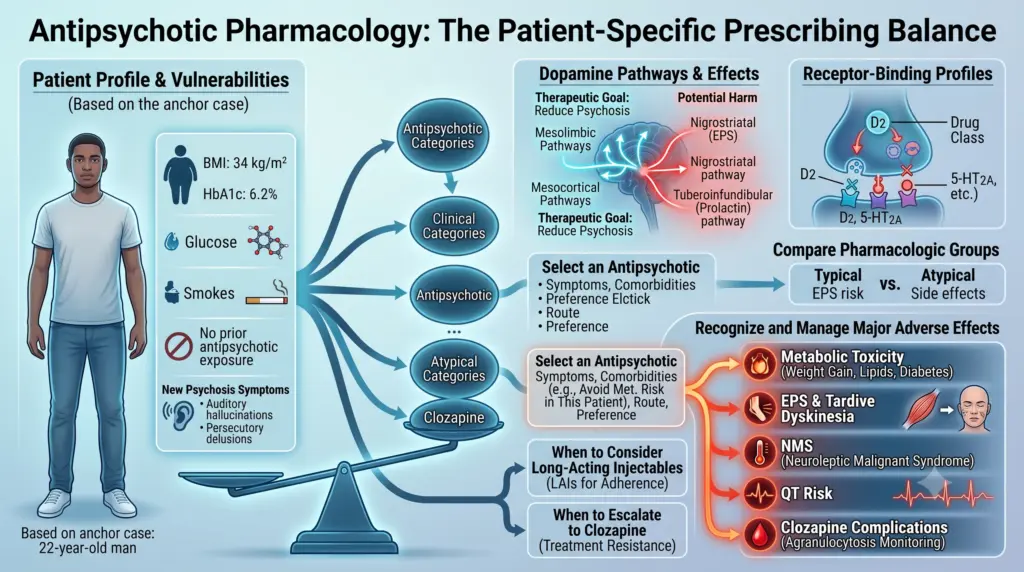
Master antipsychotic pharmacology from dopamine pathways and receptor profiles through individualized prescribing, adverse-effect recognition, clozapine safety, long-acting injectables, and stepwise treatment decisions.
Course Content
01. Antipsychotic Pharmacology: From Receptors to Patient-Specific Prescribing
You don't currently have access to this content
02. Psychosis and Schizophrenia: Define the Clinical Problem
You don't currently have access to this content
03. Dopamine Pathways Predict Benefit and Toxicity
You don't currently have access to this content
04. Beyond Dopamine: Serotonin, Glutamate, and Acetylcholine
You don't currently have access to this content
05. Classify Antipsychotics by Pharmacology
You don't currently have access to this content
06. Affinity, Occupancy, and Receptor Residence Time
You don't currently have access to this content
07. Receptor Profile Predicts Adverse Effects
You don't currently have access to this content
08. Pharmacokinetics and Actionable Interactions
You don't currently have access to this content
09. Match the Drug to the Patient
You don't currently have access to this content
10. Major Clinical Indications
You don't currently have access to this content
11. Acute Psychosis and Agitation
You don't currently have access to this content
12. Extrapyramidal Symptoms: Recognize the Timeline
You don't currently have access to this content
13. Management of Acute and Subacute Extrapyramidal Symptoms
You don't currently have access to this content
14. Tardive Dyskinesia: Detect Early and Treat Correctly
You don't currently have access to this content
15. Metabolic and Endocrine Adverse Effects
You don't currently have access to this content
16. Cardiac, Autonomic, Anticholinergic, and Sedative Effects
You don't currently have access to this content
17. Neuroleptic Malignant Syndrome
You don't currently have access to this content
18. Clozapine: Unique Clinical Benefits
You don't currently have access to this content
19. Clozapine: Initiation, Monitoring, and Red Flags
You don't currently have access to this content
20. Long-Acting Injectables: A Shared-Decision Tool
You don't currently have access to this content